October 19, 2026
I Was Weeks Away from Publishing My Novel. Then I Tore It Apart.
There might be pages all over my office right now.
Not a metaphor. Actual paper. Printed drafts from April 2025, notes in my own handwriting (slanting harder the later it got), outlines with arrows pointing at other arrows, sticky notes that gave up on being sticky a long time ago. I was supposed to be writing Silas’s book. Instead, I’ve been finding every reason not to sit down with it. Writer’s block? Imposter syndrome? Plain exhaustion? Some cocktail of all three, or something I haven’t named yet? Honestly… I don’t know. What I do know is that avoiding Silas is how I ended up sitting cross-legged in the middle of a version of Anatomy of Release that most of you will never read.
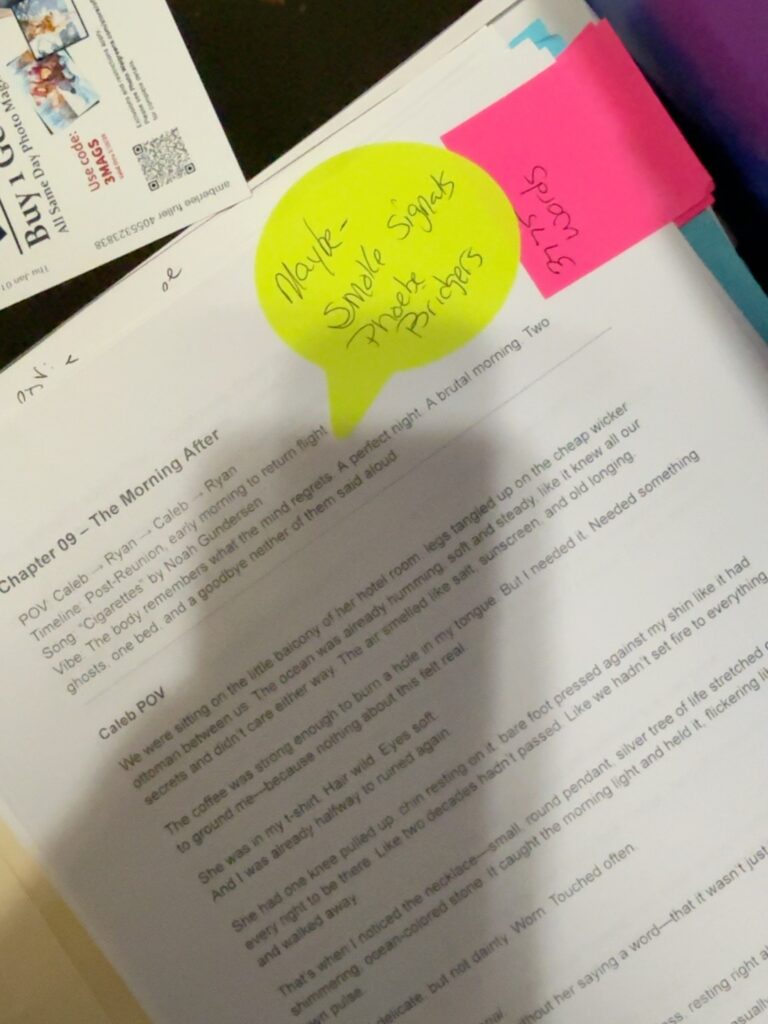
Some of it I’d forgotten writing entirely. Some of it I recognized the way you recognize a house you used to live in. The bones are right, but somebody else’s furniture is in it now. There’s Silas, in his own voice. There’s Caleb, unfiltered, thinking the things he’d never say out loud. There are scenes that made it into the book almost word for word, scenes that grew into something else, and scenes that simply… disappeared.
And somewhere in the middle of that pile, I remembered why I took it all apart.
The book that almost existed
On March 23rd, 2025, I started writing a book about Ryan Callahan, Silas Thatcher, and Caleb Jones. It was a multi-POV novel. You got Ryan, yes. But you also got Silas and Caleb directly: their thoughts, their motives, the messy internal arguments they were having with themselves while they were busy being charming (or infuriating) on the page.
I wrote the story itself in 21 days. Twenty-one. By November 2025, it wasn’t a draft anymore. It was a finished manuscript, and I was deep in formatting: trim size, fonts, chapter openers, the whole production stage. The relationships had taken shape and I knew where they were headed. And it had a publication date: December 5, 2025. On the calendar. In ink.
I want to be really clear about that, because this isn’t a story about a rough draft I wandered away from. It’s a story about a book I was getting ready to hand to strangers.
When too many voices entered the room
While I was writing it, I let people close to me read along. Chapters as they came. Their reactions, their theories, their opinions about who should end up where and who was being unfair to whom.
At first, that was lovely. Writing is lonely, and getting a text in ALL CAPS about a chapter you finished at 2 a.m. is a very specific kind of dopamine.
But somewhere along the way, something shifted, and I didn’t notice until it had already happened. By the time I sat down to format it, some of the people who’d read along were no longer in my life. And when I read the manuscript again, I could see their fingerprints everywhere. Every word was still 100% mine. I wrote every one of them. But so many of my choices had been shaped by their feedback: a scene that had gotten push back, a beat leaned into because I knew who’d love it. Feedback itself wasn’t the problem. The problem was that I could no longer find the line between their influence and my intent.
I’d look at the manuscript and think: I’m not sure this belongs to me anymore.
November 2025: The demolition
So in November, with December staring me down, I did the thing every sensible person tells you not to do.
I tore it apart.
Not a revision. Not a polish. A demolition. Here’s roughly what changed:
- Whose eyes you see through. The multi-POV structure went away. The book became Ryan’s (her grief, her choices, her version of events), with the other perspectives largely held back until the end.
- How much you get to know. Instead of direct access to Silas’s and Caleb’s heads, you learn them the way Ryan does: selectively, sometimes wrongly, and usually later than you’d like.
- Silas. His arc was substantially reworked. Same man, different road.
- Caleb. The original Caleb was a lot more golden retriever. The rebuilt Caleb is harder. Sometimes difficult, sometimes outright antagonistic. On purpose.
- The Echo sections. A new structural layer that didn’t exist the first time around.
- New people and places. Langston. The Nashville encounter. Ryan’s trip to Asheville. None of it was in the original.
None of that was cosmetic. Every change altered how you’d meet these people, how you’d read their relationships, and how you’d understand the history running underneath all of it.
And I want to be honest about the why, because it would be easy (and tidy, and a tiny bit satisfying) to say they made me do it. They didn’t. I made that call. I made it because I needed to know every choice on the page was mine, and the only way to be sure was to pick each one up and decide it again. I wasn’t trying to erase the original story. I was taking back the right to decide what the story would be.
The book that emerged
December 5 came and went without a book.
On May 19, 2026, Anatomy of Release was published as the first installment of The Echo Effect.
The book you can hold now is Ryan’s. Her experience is the doorway into everything. Silas and Caleb still have their own stories (that never changed), but how and when those stories get told has.
Here’s the part I keep turning over: the book I published is not the book I originally wrote. That doesn’t make that version worse. It doesn’t make the published version a desperate act of resuscitation. They are two different books that share DNA.
Both of them are mine.
The pages I didn’t know I still needed
Which brings me back to my floor.
I’m deep in Silas’s book (Book 2) and starting to shape Caleb’s (Book 3), and it turns out those April 2025 pages aren’t just a museum. Some of them are useful. There are early Silas scenes that remind me of things about him I’d forgotten I knew. There’s Caleb’s earlier emotional work, including his experience of compersion, written from inside his own head. There’s dialogue, small moments, and relationship dynamics that never had a home in Anatomy of Release, because it was never their book.
Now, if you’re like me, you just got all warm and fuzzy about the possibility of a director’s cut. Sorry, friend. That’s not happening. The original version of this book is basically my Karma, that legendary lost Taylor Swift album Swifties (🫶🏻) swear exists. Everybody’s heard about it. Nobody’s getting the vault edition. I’m not restoring the original. I’m rereading those pages and using them as notes, deciding one at a time, with nobody else in the room, what still belongs.
Who gets to tell the story?
Some people may ask whether I would have published the original if things had gone differently.
Maybe. It was close enough that I could have.
But I don’t actually know. I can’t. The version of me who was weeks away from publishing her debut novel no longer exists. She was fundamentally changed… and so was the book that did get published. That question stays open, and I’ve decided I’m okay letting it.
I’m not walking around mourning a book, I am wildly, ridiculously in LOVE with what came out the other side: Ryan Callahan, Silas Thatcher, Caleb Jones, Mandy Hale, Ellis Sharma, David Freeman, Ron Hammond, Jessie Tate, and every bit of their messy nonsense.
And zero regrets about cutting the dog out of the story. Silas is far too busy to be dealing with his younger sister’s dog!
Catch & Release
If you’ve read Anatomy of Release, you know Ryan Callahan has rules. A lot of them. No names. No spending the night. No “I missed you.” Leave before morning, before anyone gets the chance to memorize you. Jessie calls it the Ryan Callahan Catch and Release Program, and it’s less a joke than armor: if you’re the one who walks away first, you’re never the one left behind.
Turns out I wrote myself a version of my own.
Here’s the thing about rules, though… they never hold. Not for Ryan. Not for me. What you swear you’ve walked away from has a way of finding you again. And now April 2025 pages are back on my floor, asking if there’s still room for them.
Rule #26: If it starts to feel like a romance novel. End it.
I’m breaking that one. This time, I’m staying long enough to see what they become.
Song on repeat while writing this:
A Lot More Free by Max McNown