August 26, 2026
Five Drafts and a Ghost: How “It Feels Like a Gin Blossoms Kind of Day” Actually Got Written
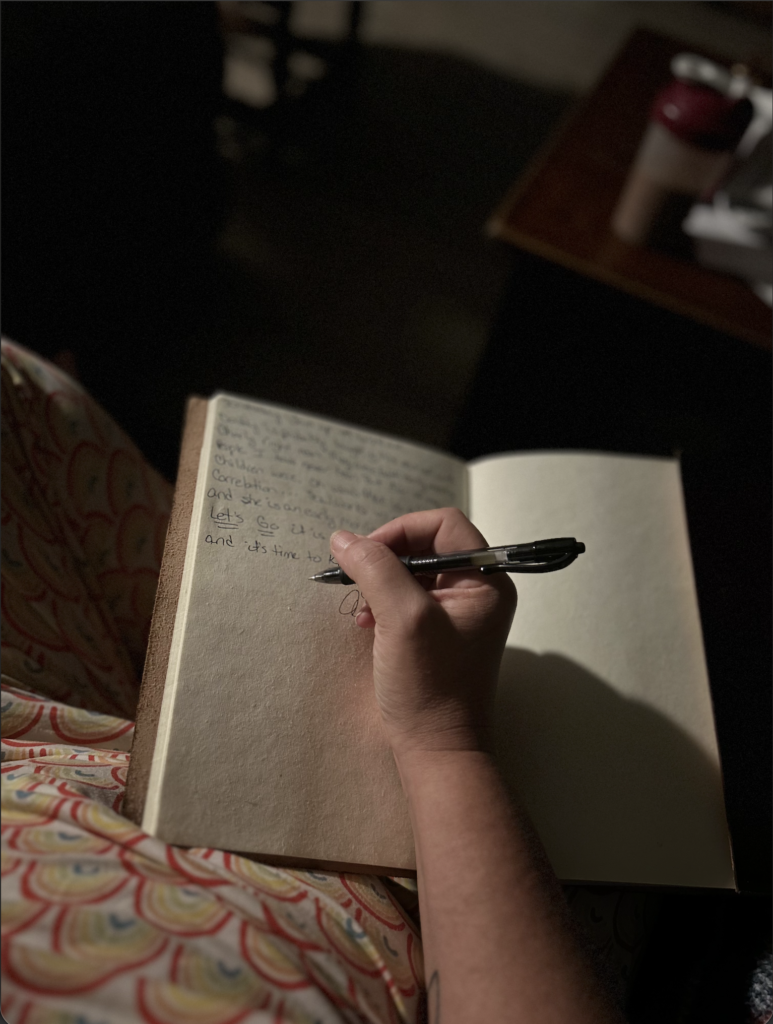
I’ve never written about this before. Never really talked about it either—how something actually gets made, from the first raw dump of feeling all the way to the thing I’m finally brave enough to hit publish on. So I wanted to show the messy process that went into the final piece.
While I was digging through old files last week—pulling pieces together for a collection I’m building—I found something I didn’t know I still had.
The original freewrite. Multiple drafts after that. Two separate “final” versions, which are different than what I actually posted. The original file is dated May 2022 and this particular piece continued to morph into what it is now until May 9, 2025.
So let’s dig the fuck in, shall we?
Draft One: The Dump
This is where everything starts. Not writing. Just… excavation. I wasn’t trying to make anything yet. I was just pulling every association out of my body and throwing it on the page before it could talk me out of it.
He was the soft landing to my crumbling. He was my permission to scream at the night sky letting years of anger and sadness escape my cells. He was my “you want to hit something? Hit me, I can take it.” He was my — have you fucking seen what my girl did?
And then the memory just kept unspooling. Every image I had of him, all out of order, all still warm:
He was my first dance it out partner. He was the pony boy to my cherry valance… “we saw the same sunset” He was my — I’m just going to lay here and hold you all night. He was my “just fucking jump already”
I wasn’t crafting a damn thing. I was just proving to myself he existed. That’s what a freewrite is, if you strip away the writer-brain vocabulary — it’s proof of life. His and mine both.
And then, buried at the bottom, the freewrite found the wound without me pointing it there:
Because of him, I was brave enough to run. He loved me and I loved him. Neither of us brave enough to let the other one know. Until it was too late.
That’s the whole thing, isn’t it. That’s every grief I’ve ever written, in three lines, before I even knew I was writing it.
Tab Two: Compression
This is the draft where I stopped dumping and started listening for what was actually load-bearing.
I took that whole factual inventory of Jerry — soft landing, permission, cherry valance, all of it — and I went hunting for the emotional architecture underneath. Not what happened. What it meant that it happened.
He crashed into me like a Gin Blossoms chorus and a stolen cigarette. My anger. His softness. My scream. His shoulder. We never said the words. But we knew. And now? I’ve danced more years with his ghost than I ever did with his hands. But I still see the same sunset.
Eight lines on the page. Ten sentences, if that’s what you’re counting. Either way—everything else got cut to the studs. It looks so fucking easy. Like I just sat down and knew exactly what needed to be there. I didn’t. Compression like that only happens after you’ve already said the long version to yourself first. You can’t cut what you haven’t fully written yet.
Tab Four: Swinging Back Out
Then I did the opposite. I gave myself room again — because eight lines proved the feeling was true, but it didn’t yet prove why he mattered. So tab four goes back outward, chasing context.
We weren’t in love, not the way adults try to measure it. But our worlds didn’t just collide — they wrapped around each other like ivy.
And this is the line that cracked the whole piece open for me, months later, rereading it:
We carried each other.
That’s the first time in any draft the relationship stopped being about what he did for me. Up until that line, every single image was him giving and me receiving. Soft landing. Permission. Arms. Voice saying jump.
And then — quietly, almost by accident — the freewrite corrected itself. He wasn’t the only one holding weight. I was holding his too. That’s reciprocity, and I didn’t plan to find it, it just showed up once I gave the piece enough room to be honest.
The Version I Actually Posted
May 9th, 2025. His birthday. Everything above — the dump, the compression, the outward swing, the single embodied memory — folded into one piece:
It feels like a Gin Blossoms kind of day. Did you see the sky? I think it means that we’ve been lost.Maybe it’s a Matchbox Twenty kind of ache: And I don’t know why you couldn’t just stay with me.
Or somehow… it’s always been the Goo Goo Dolls: Put your arms around me / What you feel is what you are / And what you are is beautiful.
In the fall of 1992, a reckless boy burst into my life— all grin and trouble and gravity. We were both too young to name what was happening, but we knew it. We felt it. It was the kind of connection that doesn’t ask permission. It just takes root. Fast. Deep. Permanent.
We weren’t in love, not in the way adults try to measure it. But our worlds didn’t just collide—they wrapped around each other like ivy. Twisting. Pulling. Growing wild. We shared air. Borrowed light. He cracked open a part of me that had never been seen, and somehow still made it feel sacred.
He was the soft landing to my crumbling. My permission to scream at the night sky, to let years of rage and sadness finally escape my cells. He was the one who said, “You want to hit something? Hit me. I can take it.” He was the have you seen what my girl did? My first dance-it-out partner. The Ponyboy to my Cherry Valance—because “we saw the same sunset.”
He was the boy who said, “I’m just gonna lay here and hold you all night.” And he did. The first time I broke apart in front of someone—really broke—he didn’t flinch. He didn’t ask me to stop. He didn’t try to fix it. With every heaving of my chest, every full-body sob I couldn’t quiet, he just held me tighter. No judgment. No fear. No shame. Just arms that anchored me, like he could hold all the shattered pieces of who I was and will them to stay. And when I hesitated at the edge of myself, he was the voice saying: Just fucking jump already.
Because of him, I was brave enough to run. Because of him, I learned that being seen wasn’t something to fear. He loved me. And I loved him. But neither of us was brave enough to say it until the window had already closed.
He would be 48 today. And I have officially had more years with his ghost than I ever had with our lives tangled together— those beautiful, messy, golden-threaded years where we didn’t just know each other… we carried each other.
So yeah… it’s a Gin Blossoms kind of day… And you know it might not be that bad You were the best I’d ever had If I hadn’t blown the whole thing years ago I might not be alone
Why I Kept All Five
I don’t usually save my drafts. Most of what I write gets its guts pulled out and rearranged so many times there’s no clean record of what it used to be. I write over myself, I don’t archive myself. Kinda like a Renaissance painter reusing their canvases. So finding this, freewrite to eventual final, every stage still standing, is rare. Jerry’s piece isn’t special because of how it got made. It’s special because it’s the one time I can actually show how my writing morphs itself into what I finally put out there.
This whole thing got “finished” right after I came out of my 21-day sprint of drafting Anatomy of Release. Pretty sure that’s not a coincidence either.
And I am sure there will be someone who looks at just the surface of this piece and thinks, “Oh! He’s the prototype for Silas, or Caleb, or some composite of both.” He’s not. That’s not what he is to any of my writing.
Jerry is evidence of the question I can’t stop writing, no matter which character’s mouth it comes out of:
What happens when somebody touches your life for a relatively brief period, changes the architecture of who you are, and then isn’t around anymore? What remains? How does love keep acting on a person after the relationship itself is gone?
I think Jerry echoes underneath all of my writing. Not the plot. More like the pulse under the plot.
Eight lines instead of forty. Compression that allows the reader to feel their own feels in that moment.
Reciprocity instead of one-way rescue. There is always more than one soul in a story of love (or grief).
One memory instead of ten. Because the right one says everything the others are saying.
That’s the shape my revision actually takes when I let it—not smoother, not more polished. Just closer to true, every single pass.
Three years passed between the freewrite and the version I published. Because that’s just how long it took for me to say “Yes. This is what we were to each other.”